Saturday, October 06, 2007

Dreaming to Dream

Is what follows an absurd exercise in mediocre existentialism, in automatic writing, in dream analysis, in delusional coercion, or in numerology? How about pure and simple rubbish? Certainly, and with all honesty, I do not know. I merely woke up and remembered having dreamt about a dream of a preceding night. There were dreams within the dream that elicited this written nonsense, a photograph I took to find distraction, and a realization that the coincidence of the two distracting events metaphorically complemented each other. Therefore, I now present both results, hoping to regret my actions in the future.


Dreaming to Dream

My grandmother and I are attempting to climb onto a terrace roof. She is 80 years old, but we have done this several times before with great agility because I am dreaming. I know the place very well because, even in a dream, I recognize it as the very same roof from whence my sister once tossed me off in an attempt to kill me. The problem in this oneiric effort is that, tired of running away from that amorphous thing that hounds us, I no longer have any strength to lift my leg high enough to secure our safety. As much as I try, my body simply does not respond. I tell my grandma that everything will be fine, that all I need to do is shift my position in order to grasp a better hold on the edge of the roof and that after this miraculous move I will be able to pull her into safety. My grandma believes me and as I try to move again nothing happens. Intermittently, I become aware that I am dreaming, but I never seem to discard the fear that fills my distorted consciousness, as I have done in other dreams. Seeking redemption, I try to fly, like I have done very well before, but the attempt is laughable. My grandmother is not aware of what I am doing; she simply sees me with my eyes tightly closed as I flap my imaginary wings to no avail. I sense that, rather than pitying me, she loves me. I look at her and corroborate the thought. She then says that there is no time left and, shifting the roles, she heroically pushes me onto safety as she tells me that everything will be fine. After her rescue, I grab her hand and try to pull her, but my muscles fail. I try with unimaginable force to move, but nothing happens. She gives me an endearing look and says that she is OK, that everything will be fine; that all I have to do is release her hand so that she can have more freedom to climb, but I do not believe her. An insidious foreknowledge of her impending fall assails me, one even more terrible because I feel that such is the result that she desires. I try to think that I am only dreaming, but the terror that invades me feels so real that I can no longer discern between dream and reality. And so, as my grandmother smiles just as her hand is slipping from mine, I open my eyes.

Under normal circumstances, I should have felt relieved. On many occasions, I have tried to force myself out of a nightmare without any success and now, half sleep, I think I should be grateful for this providential awakening. However, I convince myself that things cannot be normal after this dream. I look at the clock: 4:44 am. I immediately try to go back to sleep, convinced that if I continue having the same dream I would be able to save my grandma. As waking minutes accumulate, a sinister sense of anxiety stirs my entrails and, at 5:07 am, I have to accept the reality that I will not be able to fall sleep again.

***

My head is filled with discrepant homunculi whose orders I always defy even though I greatly value their opinion. Exceptionally, however, they all assent this morning and collude against me, unanimously suggesting what I should think. I yield for a second, but the house is a mess and I finally chose to do the cleaning and organizing I have procrastinated for weeks. Water stains on a mirror or dust on a shelf never seemed to be the revelations that now appear before me as I render their essence, in my current state of consciousness, out of existence. In fact, all annihilation of filth throughout the house relieves me. As the house progressively becomes and unrecognizable place, I develop plans to maintain it clean forever. Minimalism, out of necessity because I lack the money to furnish the place, is on my side. This austerity, however, also seems to be my enemy, for it is 7:23 in the morning and, unless I grab a toothbrush to scrub every observable crevice, the place is practically spotless.

I walk into the kitchen precisely when Homunculus 5.7 begins to mock me. Its twin, the evil one, remains silent, but I know it too well to realize its tacit agreement with the good twin. I pay no attention to them and ignore the rest just as well. I had planned to call in sick today, but, under the circumstances, that would amount to mental suicide. I prepare a very strong carafe of coffee hoping to overdose all these stupid thoughts into oblivion. Four cups and 12 minutes into the homicidal exercise, nothing seems to have changed. Ungrateful and stubborn homunculi viciously drill my head, but they seem to forget that it is because of me that they posses those qualities. As such, I win—finding unpaid bills, unreturned messages, unwashed clothes, unexplored reasons and excuses that keep me occupied until the time for work comes and a new sense of relief arrives.

The minutia of work, however intellectual it may be, is a dubious palliative to my waking nightmare that deserves no effort in mentioning it at all. Let us say that for ten prolonged hours, which seemed rather short as I experienced them, I basically did not think about the dream. For a moment I thought I should have written it down, as I always intend to record every lucid dream just in case I forget it, but it was 3:45 in the afternoon and I still could smell the fear that caused my premature awakening.

I have not done much since I returned home from work, other than constantly think about today’s events, if that is anything at all. It must be 3 or 4 o’clock in the morning. I am not afraid to go back to sleep. To be honest, I would not mind going to sleep at all. The problem is that, whether in dreams or in actuality, I never cease to be the coward unable to confront his reality, for which I only have myself to blame.

Thursday, August 16, 2007

La Duda

La narrativa que se presenta después de esta inadmisible presentación puede que sea más absurda. Su génesis se remonta a un evento igualmente estúpido. Invadido por mi innegable y repetitiva condición, alguien asumió papel de redentor (o redentora) y pontificó clichés que sin duda creyó tendrían poderes paliativos. No pude vomitar porque llevaba un ayuno de dos días. Su ecolalia plagiada de libros de auto-ayuda y su delirante suposición de que podría salvarme me obligaron a recordar el intercambio que alguna vez leí existió entre Diógenes de Sinope y Alejandro Magno. De esta forma, le pedí a tal persona que se apartara de mis tinieblas porque obstruía el espacio en que podría llegar la verdadera iluminación. Finalmente, me dejó solo, blasfemando mientras yo pensaba barbaries, y esto es lo que se me ocurrió. La conexión se da entre lo que vemos, lo que creemos ver, y lo que somos capaces de ver. Es un dilema filosófico que aún no se ha resuelto. Y, qué dicha, porque si no, todo sería perfectamente previsible.


LA DUDA

Es extraordinario que todo lo que ocurre detrás de las paredes sea perfectamente describible. Cuando niño, a pesar de que el abuelo me haya atribuido dones y que mi corazón me decía que la lógica del viejo era más exacta que la de mi madre, yo me convencí que la fantasía de mi mente pueril me obligaba a inventar cosas que al paso de los años se me olvidarían. Incluso, hasta hace poco, creí que todo no era más que una superstición, una absurda coincidencia basada en expectativas y observaciones previas. Sin embargo, muchos confirman, invariablemente, que todo lo que observo es exacto. Como esa creciente comezón en la pierna izquierda que el lector siente mientras lee lo que ahora escribo, o la aseveración de que, al descubrir el hormigueo, tal reacción no sea más que una sugestión mental manipulada por mis palabras. Sin duda, este ejercicio puede considerarse como un juego psicológico. No obstante, también sugiere la complejidad y la condición paradójica de la coincidencia inexplicable de manera lógica que usualmente reconciliamos a través de la ilógica superstición. En efecto, aquellos fenómenos de la mente que evaden los límites del paradigma en turno inequívocamente se relegan a la metafísica, que no explica nada a menos de que se le considere ciencia y que, en caso de que tal privilegio se le otorgue, se le desacreditaría rápidamente por las ciencias establecidas porque sólo explicaría la posibilidad de probar lo inexplicable. Sin embargo, es posible que el razonamiento psicológico pueda que también sea víctima de las supersticiones. Por eso, de un tiempo a la fecha, tal vez muy cercano, he dejado de creer en supersticiones y explicaciones lógicas. Acepto, quizá con el apoyo del abuelo, la fácil habilidad de describir lo indescriptible que se confecciona detrás de las paredes.

En la casa contigua, por ejemplo, una pareja fornica salvajemente. Eso se comprueba fácilmente por los gritos de satisfacción que ambos emanan. A todos los vecinos se nos ha obligado escuchar ese vulgar despliegue de emociones por lo menos dos veces durante cualquier semana. Sin embargo, él nunca ha sabido que ella finge, porque un hombre es incapaz de fingir un orgasmo y no sabe de esos métodos que las mujeres, sobretodo ella, han perfeccionado. Yo lo sé porque la he visto, extraordinariamente, a través de las paredes, con sus gestos de fastidio mientras él mantiene los ojos cerrados en su egocéntrico éxtasis. Y, la verdad, la desgana nada tiene que ver el hecho de que ella haya experimentado múltiples orgasmos con su amante horas antes del simulacro. Nunca ha estado tan fatigada como para no sentir porque, cuando él duerme, ella siempre se masturba pensando en el amante y hallando lo que nunca encontró con el marido minutos antes.

Tristemente, yo me doy cuenta de esto y otras cosas, como el caso de la niña que no puede dormir porque es asediada por fantasmas que sus padres le aseguran que no existen, pero que ella y yo vemos desde nuestro respectivo punto de referencia. O como aquel del anciano que aceptándose abandonado por sus hijos intenta suicidarse todas las noches con el flagelante cuchillo del coñac, pero despierta todas las mañanas, llorando la pena de no haber muerto alcoholizado, y se reprocha la obscenidad de haberle temido a la furia de un cuchillo verdadero. También observo las manipuladas dichas entre alcohólicos pederastas o entre exitosos hombres de negocios que festejan sus embustes creyendo que no han comprado sus conquistas. Incluso, muy de vez en cuando, también observo la intensa felicidad de madres abrazando hijos, de enamorados que libran todo obstáculo, o de artistas explotando en su nirvana durante la síntesis de una obra maestra. Lo extraordinariamente raro es que, ponderando en mi existencia y sabiéndome como objeto posicionado frente a un espejo que debe reflejarme, no he podido ni puedo ver nada de mí durante todos los años y toda la vida que he extinguido. Y así, todos los niños, todos los hombres falsos, todas las mujeres felices o infelices, todos los alcohólicos o pederastas—todas las imágenes—se concentran dentro y fuera de mi mente provocando un mareo que el abuelo trata de curar cuando me repite, incansablemente, que me ama, que debo de creer en mí, que debí de tener esperanza.

Y yo le creo al abuelo, mientras él, tristemente, me amortaja.

Friday, August 11, 2006

Before any type of precipitous and offensive condemnations assail the following commentary, allow me to say that, on the average, I admire and respect beauty for its essential and aesthetic reason alone, as this photograph testifies. This does not preclude me from forming an opinion about my experience after having been exposed to such beauty, especially since taste, and experience itself, are nothing but subjective matters. Such an opinion cannot be molded in a social vacuum, however. What I present is nothing but a perspective having been sculpted by the reality of my social experience, or, at least, what I felt during my observations of such beauty and at the time I wrote the piece. As I write this now, I am convinced that there is something more fulfilling, something more real than what I saw. Had I experienced it, the bulk of the commentary would have become nothing but a simple footnote.

It is also important to point out that, because of its political connotations, the following commentary is not an example in liberty of opinion, but an exercise in exposing the double standards that plague society. I am neither advocating for nor presenting a solution. What I do is simply present an observation; completely subjective, somewhat subversive, and perhaps a subtle example of subliminal perception. Please, allow yourself to be the judge.


A Trip

Two weeks of a badly planned trip to Western and Eastern Europe amounted, most of the time, to the mediocre sightseeing (for which I only have myself to blame) of some of the most ostentatious architectural structures ever created, ranging from imperial castles and small noble quarters to imposing cathedrals purporting to represent the greatness of god. I photographed some of them for historical and archeological reasons. Of the meager and vulnerable contemporary quarters of the common people, if they ever existed, I photographed nothing, because no map or summary in tourist travel guides suggested that they ever did. Yet, their descendants begging on the street for a few coins, even during the redemptive era of capitalist opportunity, remain faithful historians. God, I suppose, refuses to provide shelter to these people or remains busy guarding the flamboyant castles and churches after millennia of upper class abduction. Perhaps it was god herself begging on the street, a constant and paradoxical reminder that one has to look beyond the obvious and touristy to gather a better understanding of a country’s culture.

When majestic buildings were destroyed during war or communistic oppression, some were rebuilt to a larger than life reality of their previous existence. For purposes redemptive of such past, communist statues in Budapest should have been destroyed, or, better yet, as such action would have rendered all the significance of occupation as meaningless, they should have found their way into a museum with the solid intention of reminding potential deniers that the country indeed suffered a so-called occupation. These statues, however, were not destroyed after liberation, but simply removed from the city and re-edified, not in a museum, but in a remote park à la Disneyland where curious vacationers paying the touristy entrance fee of 2500 Hungarian Forints can satiate their thirst of first hand knowledge—while also having the opportunity to buy a T-shirt mocking the three tenors, or the other way around, if one is to succumb to the marketing campaign depicting Lenin, Stalin and Mao as the “Three Terrors.” The seductive qualities of capitalism with their respective marketing schemes have been more powerful and redemptive than the educated amusement—and education—that a museum can provide, I suppose.

Moving to the west, in Bavaria, to be exact, one can find Neuschwanstein, a castle that enjoys fairy tale celebrity with the imprimatur of none other than Disney, which used it—paying the rights?—for the ubiquitous promotional that has so obsessed the infantile minds of children and adults who believe the disneyfied depiction of reality. From Sleeping Beauty to Cinderella to Disney itself, the exuberantly portrayed silhouette of this castle, in conjunction with astounding pyrotechnics and an enthusiastic musical score on the background, has been the representative image for this corporation. If one knew the history of the castle, all disneyfied meaning would be spoiled, but that is a matter of another piece.

On my way to Munich, before meeting face to face with Neuschwanstein, I encountered the fairy tale theme on the plane while watching an in-flight movie, not a film, about James Braddock, a lower class boxer who was nicknamed the Cinderella Man for vicariously representing Irish redemption during The Great Depression, given that he rose from pugilistic oblivion to defeat the heavy weight champion in America at the time: Max Baer. Braddock, the movie shows, was a simple and good man, honest, incorruptible, and perfectly capable to forgo food even during the night of the fight to a mercilessly depicted Baer in order to give it to his own children. After seeing all those castles in Europe, especially the Cinderella castle, I wondered if the house that Braddock bought in Jersey with the money he earned after the fight with Baer would ever become a tourist trap in 300 years.

I have to admit that as someone with strong inclinations towards the socio-historical context of reality, archeological sites provide fascination and a solid reference point. Rome, Egypt, and Mesoamerica are simply a few examples. Yet, during this trip, I became convinced that Braddock’s house in Jersey, although with the potential of becoming the subject of historians such as Howard Zinn or Eric Foner, would never get approval from the censors of fairy tale reality, even though imposing castles promise to forever remain the subject of reconstructed reality for generations to come. There might be hope for less deserving structures. After all, Bulgakov’s flat at the time he wrote Master and Marguerita became an informal museum in Moscow, even during communist rule, and it has now become a formal café and museum. Can we assume that MLK’s legacy, not his property, in these times of so-called democratic freedom would ever become monumental without so much arbitrary appropriation and co-option after his murder?

Archeological sites, I suppose, at some point become arcane. Most of the time, they seem to do it when their significance is too close in time with the reality of subjects who observe them. Not without reason, there have been several revolutionary attempts to destroy the significance that imperial structures represent, the actions of the Boston Tea Party being but simply one example. To whom does reality belong? To whom does historical knowledge?

In Moscow, I saw Lenin embalmed, not alone from 10am to 1pm, but lonely all the time in his mausoleum. He died in 1924, a mere 82 years ago, but some tourists argue that he has become arcane while they ponder on the magnificence of millennial edifices that surround him. “It’s ridiculous how much money they spend in preserving that body,” one furious tourist proclaimed, although he could not resist the lure of that ridiculously preserved body. “Hey, Honey!,” his wife responded. “Look at that church!” “Yeah! It’s beautiful,” he said. “Let’s go see it.” In no way do I intend to assert any comparison of significance or character between Lenin and Jesus, but I could not help wondering if this tourist would embrace the same feelings if the embalmed body of Jesus, expensively preserved, turned out somewhere in Lebanon after the Israeli bombing. Perhaps it takes more than 82 years, or royal extraction, to ensure the validity of a ridiculously expensive prefabricated posterity, as I surmised after visiting the St. Stephan catacombs in Vienna, which contain the tombs of Duke Rudolph the Founder and 14 other members of the Habsburg family, along with 56 urns preserving some of their royal organs. After an agitated dissertation about how great it was for such site to have been preserved because of the significance of the royal tombs, an infatuated tourist concluded: This is great history, you know? There was no mention of thousands of preserved bones belonging to the common people, which we had seen less than five minutes earlier, as this catacomb also served as a mass grave during the black plague. History, perhaps, remains a subjective matter.

Tired of castles, monuments and mausoleums, I embarked my unpreserved body back home, unable to reconcile my expectations about the trip with my experience, but already planning another trip to territories where perhaps the magnificence of undeveloped land would be the majestic attraction. A photo-essay depicting sand dunes that I saw in a Swiss Air magazine I found at the Munich airport seemed to serendipitously corroborate my belief that Africa should be my subsequent destination. Yet, memories of my unfinished trip still bothered me. The foreknowledge of several vacuous hours of flight worsened my frustration. I had to study for an upcoming make-up exam on research methods, but I could not gather the strength to go over research design, random sampling or ethical considerations when my experience had been arbitrarily skewed to see that which an artificial portrayal of history imposed on me. Hollywood movies such as Cinderella Man, 16 Blocks, Shaggy The Dog, and 8 Below were featured on that return flight. Not willing to concentrate, I watched some of them, running away from my reality, including that of studying, but mainly avoiding V for Vendetta, what I expected to be a movie with Die Hard tendencies in which an all-American hero turns vengeful to his own system after experiencing the reality of entrapment.

After a few minutes of 16 Blocks, I changed the channel because Bruce Willis was again playing himself, or one of his roles in the Die Hard series, which is basically the same. Flipping through channels, a female British voice seduced me: “Remember, remember, the fifth of November, the gunpowder treason and plot. I know of no reason why the gunpowder treason should ever be forgot.” Serendipitously, I found the reconciliation to the frustration that had anguished me.

V for Vendetta is a film, not a movie, about an anarchical concept personified by V, who in turn personifies Guy Fawkes, one of several co-conspirators who attempted to blow up the British parliament on November 5, 1605. V, having been incarcerated and tortured in a dystopic British regime resembling the one of Nazi Germany, plans an exuberant revenge aiming at redeeming not only the Gunpowder Plot of Fawkes, but also the subjected population of his country. An anti-hero superceding the role of any antithesis, V succeeds, making elaborate use of beautiful pyrotechnics, music, and Shakespearean language (For those who may even dare argue that I am condoning terrorism, please see all the early reportage from the Los Angeles and New York times about the Iraq invasion in which photographs depict missile launchings and explosions as beautiful images and use the language of Shakespeare to condone the paradox).

As you can imagine, I loved the film, for its anarchical meaning and because it provided me with the reconciliation I was searching for. After this film, my trip became vindicated. At least vicariously, I was able to blow up all those structures that rendered my trip meaningless and whose arbitrary significance so troubled me—even with awesome fireworks and the great 1812 Overture by Tchaikovsky, which Disney would have probably approved of.


As reality is sinking in, however, I now have to develop the courage to see a film in which Yale frat boys blow up Mayan archeological sites in the name of national security.

Wait a minute! For that I need not wait for a lame screenplay, but simply tune in to reality and move the location from Mesoamerica to Mesopotamia, as such arbitrary imposition of reality is currently happening in Iraq.

(Does anyone want to argue about Terrorism?).

Sunday, July 16, 2006


La fotografía llegara después. También la ortografía.
Estamos pues en Munich, rumbo a Moscú no en búsqueda de nada, sino en logro de encuentro. A pesar de la estética, Europa del oeste ya no es un área que me inspira y satisface. No sé. Quizá tiene que ver con el hecho de que estoy sobre- informado y lo poco que sé no es compatible con mi esencia. Supongo que los castillos y la esencia que detesto de ellos en 3000 años representarán algo similar a zonas arqueológicas que admiro hoy. La relatividad, aunque partidaria, cada día me envuelve más. Ya veremos que me despierta Europa del este. Me hace más ilusión que esto, aunque le he disfrutado.

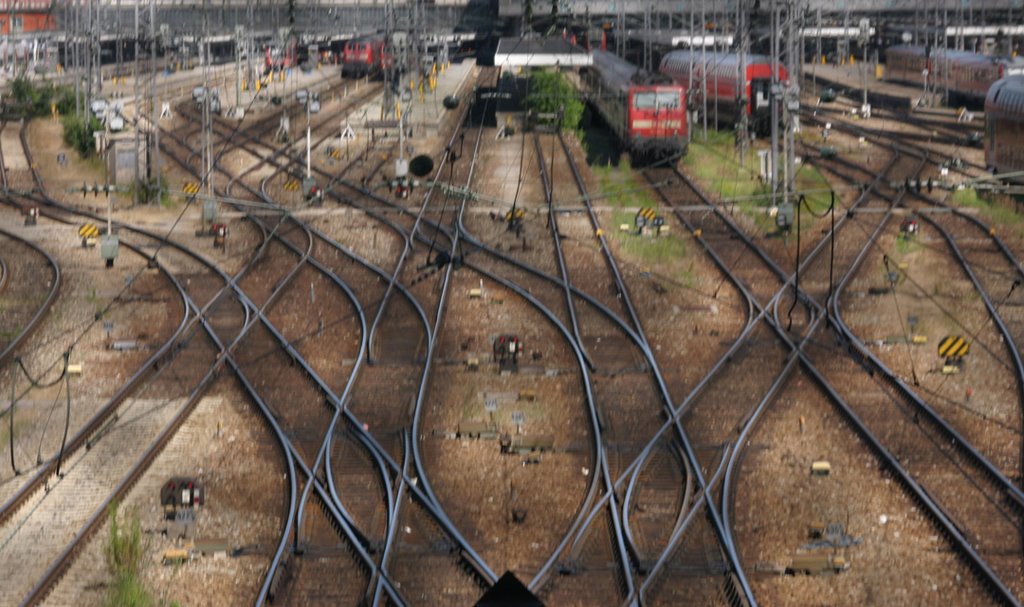
El registro anterior lo escribí en Munich, un tanto apresurado y cansado, con la falta de ortografía que un teclado con despliegue Alemán permitió, la cual he arreglado. La fotografía que le precede la tomé unas horas antes, a través de una malla metálica que le da un efecto borroso. Habiendo regresado, me di cuenta que esa fotografía era consonante con el comentario e, incluso, también con la encrucijada que significó el viaje en su totalidad. Es decir, lo difuso de la imagen representa mi punto de vista, no tanto por lo borroso, sino porque esta filtrado por los lentes de mi perspectiva. Las bifurcaciones viarias, de la misma forma, representan los múltiples discernimientos que se pueden obtener de un viaje y yo, cansado de la pasividad de términos medios, he tomado partido y he decidido interpretar mi viaje de forma a-turística, para no llamarle subversiva. El registro que continuará a éste incluirá fotografías y un comentario en el cual expongo tal punto de vista.

Tuesday, July 04, 2006

Short Story: The Urge

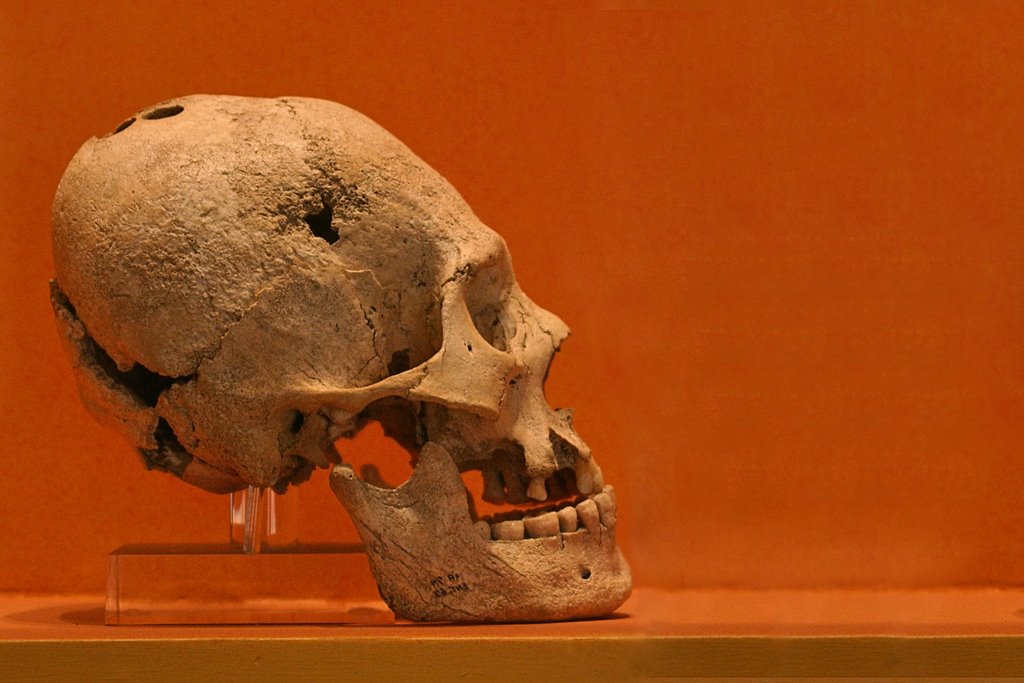
This is a photograph of a skull found in Monte Alban, Oaxaca depicting trephination (the drilling of the skull to allow evil spirits to escape) and the characteristic artificial deformation of the skull that this culture regarded as important in their conception of beauty. The significance of this photograph seems to have some paralles with the following short story that I wrote a few months ago.

The Urge


Yesterday, for the first time in years, I once again felt an irresistible urge to kill.

My first possession by the urge, or at least the first time I remember it, was when my father, that repugnantly malodorous and drunken thing I had for a father, took me out for my sixth birthday. He knew I detested going to that woman’s house; how much I hated that rancid smell of cigarettes and those stupid attempts at winning me over with frivolous and hypocritical gifts, but he didn’t care. We both knew we visited her because it was he who wanted to be there, he who desired to find placid relief from the onerous existence he had with my mother. I was simply the perfect alibi. We arrived and his languid demeanor turned into childish foolishness. They kissed and embraced as if they had not seen each other for ages and completely forgot about me. I was relegated to watch them from an unlit corner seating on a stained sofa, forced to become a senseless spectator of their progressive drunken madness that drilled my senses. They had a ball, drinking wine and caressing each other while exchanging dirty jokes they were convinced I wouldn’t understand. I felt nauseous all the time, mainly after they left me in the living room because they needed “to talk adult things.” Talk? Talk? All I heard were giggles and moaning. I wanted to kill him! I wanted to kill him so badly and I wanted her to be the next! That’s not the way to treat a child, especially during a birthday. Besides, I reasoned, that was not the relationship two cousins were supposed to have.

It was hard not to think about killing growing up the way I did. The silence in my house, which my mother procured with the silent militancy of a tyrant, was so murderous that it awakened similar tendencies in me. Television or radio was off limits. Even murmuring to my sister was out of the question in the presence of my mother. When I became engrossed while reading a story and emitted a faint laugh of amusement, all my mother had to do was look at me with her tyrannically silent gaze to remind me that rules were not supposed to be broken in her house. That absurd silence was so burdensome and prolonged that I grew to like those murderous tendencies it elicited. Killing everyone every night, at least in my mind, gave me some sort of comfort and control over my life.

The few times my parents actually spoke to each other the only thing I heard were blasphemous imputations about how miserable their joint life had been. I particularly hated dinner time. I never understood why we had to engage in such a deceitful ritual if the only thing in their mind was to kill each other. Unable to act on their urges, they displaced their anger on me. As if I was to blame for not wanting to eat, for getting bad grades in school, or for wetting my bed at night.

Over the years, I of course found out that my father and that woman were indeed not cousins. The real aunt showed up at the door one afternoon and she didn’t resemble the Aunt Mary we knew. My mother decided to leave. “Great,” I thought. I was certain that her husband was responsible for all the madness in that house and thus felt truly glad to leave. She grabbed a coat, the car keys and looked me in the eyes saying: “You fucking panderer. You betrayed me.” I haven’t seen her since.

Had it not been for my sister, it would have been really nice to stay in that house, which was, most of the time, empty. Following his M.O. from the time we were a nuclear family, my father continued not to ever care about us. Sure, he paid for everything, but his most important interest was to roll around in bed with his “cousin,” or with the sitter he hired to care for us after he returned from seeing his cousin. Even after all women dumped him, he never became the bitter macho displacing the anger of his impotence on others. He became, in fact, quite harmless. He would come home late and, without even making sure that we were OK, would place his inebriated ass to sleep. My sister, however, was a real plague. She didn’t take our mother’s abandonment well and blamed me for everything. When she wasn’t exploring her sadistic tendencies on me with a knife in hand, she would beat me to the ground, ranting about all the ways I deserved to die because I was responsible for her misery. I wanted to kill her too, really wanted to do it and imagined the many ways in which I would dismember her body and throw the pieces to the dogs, but never acted upon it. How could I? She was my sister, after all. Besides, there were also good times, very few, but nonetheless important for me. She bought me ice cream on my tenth birthday, for example.

The spectacle of death emanating from someone’s eyes with the resolute intention of killing has a terrifying effect on the sight receptors of the potential victim. That’s what my sister taught me the first time I acted on my urge to kill. She had been grabbing me all over the place and, once again waving her puny knife, ordered me to pull my pants down to do dirty things with her. I couldn’t take it. Not anymore. I looked at her with a murderous hatred that she sensed. “Don’t you dare do anything stupid,” she said terrified. Something snapped in my head and I laughed vengefully. She started to cry and I jumped on her, biting and kicking, but not with enough momentum to push her off the terrace floor before she shove the knife into my stomach. “It was an accident,” she yelled as I rested on the floor, bleeding profusely, but still with the determination to show her how much I hated her with my eyes. “It was an accident,” she told everyone hard enough that they believed her. To be honest, I really wouldn’t have minded dying. It felt rather peaceful for a while; no urges, no screams, nobody telling me what to do. Just a plain and soothing little light that the more I tried to grab, the more that it evaded me. I survived, regretfully, but never went back home: I ran away from the hospital the day before I was supposed to be released to my loving family.

Time after time, countless therapists have told me that I am a rather resilient person. After all, they said, I survived abuse and neglect and lived a few years on the streets managing somehow to be not only street-smart, but also book-smart. I love to read, but—please!—arguing that the mediocre vicarious living I gathered from the stuff I read is what saved me from the streets is ludicrous. I profanely dared every single one of them lazy therapists to try to survive the way I did by simply reading Freud, but they dumped me seconds later. They couldn’t take the challenge because life in the streets is not that easy. A meager little book or the heart-felt blessing of an old lady is not enough. In fact, the second coming of Christ is not enough. Picture this: You want to go to sleep but can’t, because you are terrified that someone—whether of your same luck or a pervert who preys on those of your same luck—will come to grab your ass to decimate it with every conceivable object in the imagination of sadistic sodomy. Or how about this: You haven’t slept in two days but are terrified to close your eyes because you’ve seen how your best buddy gets mercilessly stabbed in the heart in exchange of a lousy blanket and the three dollars he had in his pocket. You think Tolstoy is going to save you from that? You think the Bible is going to give you peace of mind? You think Saint-Exupery will inspire you with the altruistic musings of his little prince? How about the streetwise encyclopedia of drinking-your-
fucking-way-to-sleep-so-that-your-fucking-drunk-ass-doesn’t-feel-when-
they-fucking-stab-you? For me to claim that those years were the truest rendition of hell would be an understatement. I don’t even wish this to happen to my mother for having forsaken me, as much as I resent her. Having to always watch my back and being forced to be ready to kill at any time was worse than hell. Sometimes I wished I wouldn’t have had to do it.

During the final days of my life in the street the central library was my sweetest refuge. That open space, those high-vaulted ceilings, that remarkable silence that reminded me more of peace than murderous inclinations in my memory coalesced to signify that which I had imagined for a home. I wanted so badly to sleep there, if only for one night. Not only would I have had a clean bathroom and plenty of entertainment, but, mainly, no one threatening my safety. I had to console myself in reading there most of the day and stealing the books to keep me company at night.

The trade of stolen books was, in fact, my main means of survival for a while. The central library, for some reason, had a good number of first editions of famous authors still in circulation. I didn’t come to this realization alone, of course. I was panhandling at a local diner when a disheveled yuppie who wanted to look like me grabbed the copy of Ulysses I was holding in my arm. “You are reading Joyce?” he asked. “Not yet” I said. This is worth thousands, he said after inspecting it. “It’s a first edition!” My eyes glittered. We settled for $200. I was a rookie then. Later that night, with the $187 dollars in my pocket after a nice dinner, I stole a 1960s copy of the same book from a used bookstore that was selling it for $1.99.

Blinded greed, I stole books from the library left and right. It was a rather easy way to survive, supported by the state, which owed me so much anyway. Nevertheless, I felt guilty. So much that when Lucy, the librarian, approached me one afternoon, I almost told her the truth. She came to me, however, because she had observed me and had taken a liking to my reading habits. She had a beautiful smile and a very placid way of saying things. She gave me a tour of areas of the library I had not seen and introduced me to books I would have never imagined picking up. Over the weeks, I grew comfortable to the attention she paid to me. She was in love with mystery and crime novels, which I didn’t care for. The classics are my thing. I learned better survival skills from them than from those stupid crime novels. Most cops sense you are trying to fool them with a tactic you’ve read in one of those books, but few are capable to defy the arguments exposed by Socrates or the morals of Aesop. At least, my quasi-philosophical ranting gave me time to run away. Nonetheless, Lucy explained that those books allow you to run away from everything to become part of an alternate reality. I knew that she would run for cover if she experienced those things in her own flesh, but disregarded such observation because she truly believed her arguments. I appreciated them because she shared them to me with passion and with no intention to convince me. Her nurturing voice was sufficient to persuade me.

Lucy finally adopted me after realizing that, during the day, the library was my home. Life was good afterward. I had a clean bathroom, a bed, the opportunity to go to school, and the safety of a home. More importantly, I had Lucy, who kindly declined my offer to call her mom, and J.P., the best brother I could have ever wished to have. Even then, and as resilient as I was described to be by those therapists, the urge to kill crept up every once in a while. I suppose that was the toll of having to watch my back all those years on the streets.

I don’t remember when the urge finally abandoned me. What I do remember, however, is sitting at work realizing that for several months such thought had not invaded me. It was a rather strange feeling, like losing an organ or one of your senses. I tried to elicit the urge on command, but it didn’t come. I also noticed that I was less paranoid and more trusting. “So this is what true life is like,” I thought. I closed my eyes in an attempt to get used to my new reality, but another feeling of paranoia invaded me within seconds: “What if the urge returns?” I feared. Despite the weird feelings, I felt good, like I never had in many years. In fact, I felt really good for over 15 years. Yesterday, however, my fear materialized.

When I reached the van, parked in an isolated underground level of a convenience store, they weren’t fucking anymore. He was pulling his pants up, playing with his dick and asking her if she had ever tasted so good a thing. The bitch was still naked, pleading for another fuck. My world didn’t collapse, didn’t shatter in millions of pieces, but merely imploded in an onerous feeling of dispossession. She kept pleading for more and the son of a bitch laughed.

-I’ll fuck you all the times you want next week, while your husband leaves for that conference and my lousy wife believes I went on a business trip.

My world exploded in rage. Possessed, I pulled the bitch out by the hair and threw her on the floor. He got out of the van and grabbed me, trying to control me. When I looked him in the eyes, I saw the same fear that afflicted my sister years earlier. Sensing the gun that the years on the streets have forced me to carry for protection, he let go, sobbing and pleading for his life. The bitch ran away. I looked at him and laughed vengefully. My head snapped and I felt something click. Had my head finally come back to its senses? With a peaceful determination and without turning back, I got in the van and drove away, throwing the gun in a dumpster before I arrived home.

He won’t have to complain about me anymore and I won’t have to listen to his stupid excuses, which I tolerated without an inch of resentment. More importantly, the urge will never return because its constant reminder lies in a trash can. At least, that’s what I think, because there must be more than one way of killing a lousy husband.

Vida de Trapos


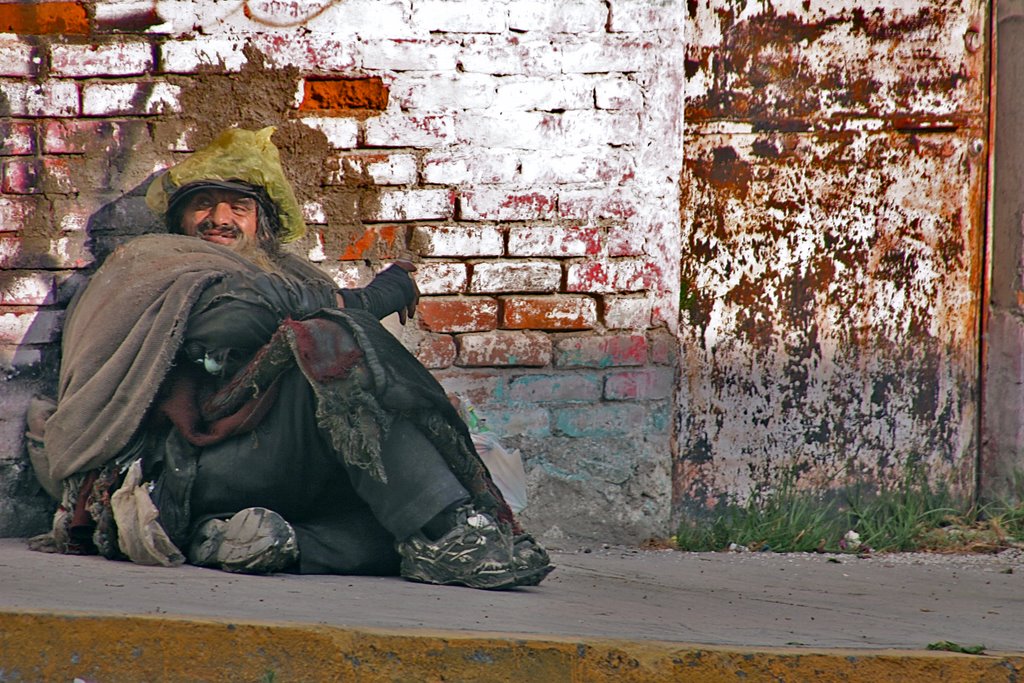
Esta fotografía la capturé mientras daba vueltas al rededor del vecindario en donde viví hasta los diez años, en la ciudad de Toluca, Estado de México. Iba manejando y me sentía algo decepcionado de que el miedo a la inseguridad o la obsesión de sentirse seguros obligara a los habitantes de la ciudad a construir grotescos enrejados en propiedades que durante la niñez consideré bellísimas y notables para fotografiar. La imagen de este hombre, libre de todo miedo u obsesión, excepto aquellos conllevándolo a su condición, desarraigó toda desilusión. En cuestión de estética, el marco, en mi opinión, era perfecto. Tengo que admitir que a lo largo de los años en que he fotografiado personas indigentes durante mis viajes mi motivación es, aparte de artística, también política porque sirve de testimonio que en países supuestamente ricos y avanzados como Inglaterra o Alemania la pobreza permanece y sus víctimas suelen ser personas de color. En este caso, mi motivación –u obsesión- fue netamente artística. Supe que si dejaba pasar esa oportunidad nunca me lo perdonaría. Racionalizando, quizá porque estaba en búsqueda de algo bello en una ciudad progresivamente cubriéndose de horribles celosías, la imagen de este hombre, paradójicamente, se me develó como grotescamente bella.

Sunday, January 01, 2006

Monday, November 21, 2005

Light Vanquishing Darkness

Given this photograph, I feel obliged to say that describing anything related to Disney, especially in conjunction with Frank Gehry's architectural style, necessitates an exercise in deconstruction.

In many respects, I have openly criticized Disney for--what else?--the disneyfication of important aspects of culture. In line with Critical Culture Theory, my observations about what the company represents are nothing but a group of multiple readings or discernments outside of mainstream society‚—or what Disney would like us to believe. If the status of progress in the world were as fine as this or other companies claim, their continued practice of using mass communications means to persuade us seems not only contradictory, but unnecessary, as it would be a given widely accepted. Yet, dissenting opinions continue to arise, a reason for which at one point I asserted that such persuading attempts were meretricious, in the symbolic and etymological sense of the word.

As an observer behind the eyepiece of a camera, however, I was compelled to deconstruct not the significance of the Walt Disney Music Hall, but its image, to the simplest form. Endeavoring to deconstruct its significance would have been nothing but an apology for my photographing of the building by claiming that it is beautiful and separate from what Disney stands for. That, in essence, would have rendered my rationalization, and the photograph itself, as meretricious. In fact, I automatically deconstructed the image of the building to its geometrical lines because, on the average, I do not believe the building is beautiful. Although acoustically laudable, it has proven to be impractical and, upon reflection, heatedly annoying, the reason for which its smooth titanium surface had to be scraped to perfection. Yet, that night‚—September 15 of 2005 and the second time I had actually seen the building‚—there was something different and beautiful about its image. I took several close shots, progressively retreating until I found myself on the opposing corner, wondering what the hell was so besieging about it. After several more shots, the one depicted here being the penultimate, I felt confused, questioning why my deconstructive and introspective exercise seemed to have turned into a holistic and gestalt-like realization.

Feeling like one of Koehler‚’s monkeys, a pair of guys interrupted my ruminations. They had been observing me but I was completely unaware of their presence, engulfed in the photographing experience. They were eager to see some of the images because they were the illumination technicians responsible for the enrapturing aspect I was trying to discover and they knew about all along. In fact, according to them, that night was the very first time the building had been illuminated and they were tuning the details to complete the task in the most aesthetically pleasing way. Although they did not like the photographs, as they deconstructed them to the simplest form of illumination, which, to them, left much to be desired, I felt grateful. I am not certain if I would have independently realized that the light was the culprit of the magic that night, but after their disclosure, I understood that the reflection of light on those metallic walls was what made the whole panorama interesting. That is why I chose to transform the photograph into black and white and still consider that, in spite of all, the deconstruction to the basic elements of light and darkness absolves me from having photographed something so meretriciously disneyfied, as my focus was not the flashiness of the complete product, but the balance of light and darkness in the randomness of existence.

Monday, January 24, 2005


Mi Primera Fotografia Artistica